

Transformations
The Skill
A transformation changes the position or size of a shape. There are four types you need to know.
1. Reflection
A reflection creates a mirror image across a line of reflection.
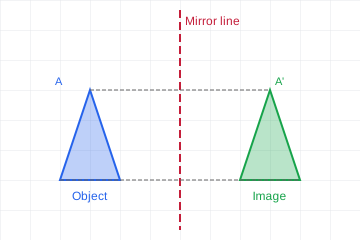
To describe a reflection: State the mirror line (e.g., "Reflection in the line $y = x$").
Key properties:
- The image is the same size as the object
- Each point is the same distance from the mirror line
- The object and image are congruent
2. Rotation
A rotation turns a shape around a fixed centre of rotation by a given angle.
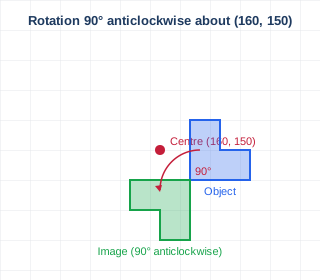
To describe a rotation: State the centre, angle, and direction (clockwise or anticlockwise).
Example: "Rotation of 90° anticlockwise about the point (2, 1)"
3. Translation
A translation slides a shape without rotating or reflecting it. Described using a column vector.
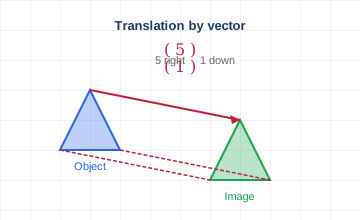
$$\text{Vector } \begin{pmatrix} a \\ b \end{pmatrix}$$
- Top number ($a$): horizontal movement (positive = right)
- Bottom number ($b$): vertical movement (positive = up)
4. Enlargement
An enlargement changes the size of a shape from a centre of enlargement by a scale factor.
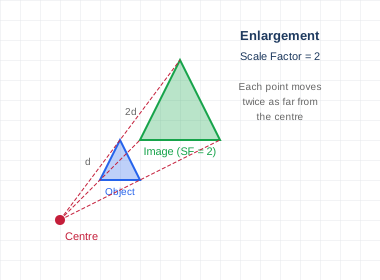
To describe an enlargement: State the centre and scale factor.
Scale factor rules:
- SF > 1: shape gets bigger
- 0 < SF < 1: shape gets smaller
- SF < 0: shape inverted (on opposite side of centre)
For area: multiply by (scale factor)² For volume: multiply by (scale factor)³
The Traps
Common misconceptions and how to avoid them.
Confusing clockwise and anticlockwise "The Direction Dilemma"
The Mistake in Action
Rotate shape A 90° clockwise about the origin.
Wrong: Rotates the shape anticlockwise
Why It Happens
Students mix up clockwise and anticlockwise, especially under exam pressure. Some also confuse which way is "positive" rotation.
The Fix
Clockwise: same direction as clock hands move ↻ Anticlockwise: opposite to clock hands ↺
Tip: Imagine the shape is on a clock face. Which way would the hour hand move?
On coordinate grids:
- 90° anticlockwise from positive x-axis goes to positive y-axis
- 90° clockwise from positive x-axis goes to negative y-axis
Using tracing paper helps! Put your pencil on the centre and rotate the paper.
Spot the Mistake
Rotate 90° clockwise about the origin
Rotates anticlockwise
Click on the line that contains the error.
Enlarging from wrong point "The Centre Confusion"
The Mistake in Action
Enlarge triangle ABC by scale factor 2, centre O.
Wrong: Each vertex moved 2 squares away from its original position.
Why It Happens
Students apply the scale factor to the shape itself rather than to the distances from the centre of enlargement.
The Fix
For enlargement:
- Draw lines from the centre through each vertex
- Multiply the distance from centre to vertex by the scale factor
- Mark new vertices along these lines
- Join the new vertices
Scale factor 2 means each point is twice as far from the centre as before — not twice as far from where it started.
Key insight: Draw ray lines from the centre through each vertex, then extend.
Spot the Mistake
Enlarge by SF 2, centre O
Each vertex moved 2 squares from its original position
Click on the line that contains the error.
Incomplete transformation description "The Missing Detail"
The Mistake in Action
Describe the transformation from shape A to shape B.
Wrong: "A rotation of 90°"
Why It Happens
Students correctly identify the transformation type but don't include all necessary details. Different transformations need different information.
The Fix
Each transformation needs specific information:
Reflection: the mirror line "Reflection in the line $y = 2$"
Rotation: centre, angle, AND direction "Rotation of 90° clockwise about (0, 0)"
Translation: the column vector "Translation by vector $\begin{pmatrix} 3 \\ -2 \end{pmatrix}$"
Enlargement: centre AND scale factor "Enlargement, scale factor 2, centre (1, 1)"
Memory aid: Think "What, Where, How much?"
Spot the Mistake
Describe the transformation
A rotation of 90°
Click on the line that contains the error.
Wrong signs in translation vectors "The Vector Sign Slip"
The Mistake in Action
Shape A is translated to shape B. A moves 3 left and 2 up.
Wrong: Vector = $\begin{pmatrix} 3 \\ 2 \end{pmatrix}$
Why It Happens
Students forget that left and down are negative directions. They write the numbers without considering direction.
The Fix
In a translation vector $\begin{pmatrix} a \\ b \end{pmatrix}$:
Horizontal (top number):
- Right = positive
- Left = negative
Vertical (bottom number):
- Up = positive
- Down = negative
3 left and 2 up = $\begin{pmatrix} -3 \\ 2 \end{pmatrix}$
Check: Trace a point — does it end up in the right place?
Spot the Mistake
A moves 3 left and 2 up
Vector = $\begin{pmatrix} 3 \\ 2 \end{pmatrix}$
Click on the line that contains the error.
The Deep Dive
Apply your knowledge with these exam-style problems.
Level 1: Fully Worked
Complete solutions with commentary on each step.
Question
Describe fully the single transformation that maps shape A onto shape B. [Shape A has vertices at (1,1), (3,1), (3,3). Shape B has vertices at (1,5), (3,5), (3,3)]
Solution
Step 1: Identify the transformation type. The shapes are the same size and shape but flipped — this is a reflection.
Step 2: Find the mirror line. Look at corresponding points:
- A(1,1) maps to A'(1,5)
- The midpoint is (1, 3)
- B(3,1) maps to B'(3,5)
- The midpoint is (3, 3)
All midpoints lie on the line $y = 3$.
Answer: Reflection in the line $y = 3$
Question
Triangle P has been transformed to triangle Q by a single transformation. Describe fully this transformation. [P at (2,1), (4,1), (4,3) → Q at (1,-2), (1,-4), (3,-4)]
Solution
Step 1: Check it's a rotation.
- Same size ✓
- Not reflected (orientation preserved) ✓
- Not simply translated (position changed in a turning way) ✓
Step 2: Find the centre of rotation. Using tracing paper or perpendicular bisectors of AA' and BB': Centre = (0, 0) (the origin)
Step 3: Find the angle. Point (2,1) → (1,-2) This is 90° clockwise (or 270° anticlockwise).
Answer: Rotation of 90° clockwise about the origin (0, 0)
Question
Enlarge the triangle with vertices P(2, 1), Q(4, 1), R(4, 3) by scale factor 2, centre the origin (0, 0).
Solution
Step 1: For each vertex, multiply both coordinates by the scale factor.
Scale factor 2, centre (0,0):
- Each point moves twice as far from the origin
P(2, 1): distance from origin × 2 P'(2×2, 1×2) = P'(4, 2)
Q(4, 1): Q'(4×2, 1×2) = Q'(8, 2)
R(4, 3): R'(4×2, 3×2) = R'(8, 6)
Answer: P'(4, 2), Q'(8, 2), R'(8, 6)
Check: The side PQ was 2 units, P'Q' is 4 units (×2) ✓
Level 2: Scaffolded
Fill in the key steps.
Question
Translate the triangle with vertices A(1, 2), B(4, 2), C(4, 5) by the vector $\begin{pmatrix} -3 \\ 4 \end{pmatrix}$. State the coordinates of the image.
Level 3: Solo
Try it yourself!
Question
Enlarge the triangle with vertices A(1, 1), B(3, 1), C(3, 2) by scale factor $-2$, centre the origin.
Show Solution
With a negative scale factor, the image is on the opposite side of the centre.
Scale factor $-2$ from origin (0,0):
A(1, 1): A'(1 × (-2), 1 × (-2)) = A'(-2, -2)
B(3, 1): B'(3 × (-2), 1 × (-2)) = B'(-6, -2)
C(3, 2): C'(3 × (-2), 2 × (-2)) = C'(-6, -4)
Answer: A'(-2, -2), B'(-6, -2), C'(-6, -4)
The image is inverted (upside down) and on the opposite side of the origin.
Question
Triangle ABC has been enlarged to triangle PQR. AB = 3 cm and PQ = 7.5 cm. Find the scale factor of the enlargement.
Show Solution
Scale factor = $\frac{\text{image length}}{\text{object length}}$
$$\text{Scale factor} = \frac{PQ}{AB} = \frac{7.5}{3} = 2.5$$
Answer: Scale factor = 2.5
Check: $3 \times 2.5 = 7.5$ ✓
Examiner's View
Mark allocation: Describing a transformation: 2-3 marks. Performing a transformation: 2-3 marks.
Common errors examiners see:
- Missing one part of the description (e.g., forgetting direction for rotation)
- Wrong sign in translation vectors
- Drawing enlargements from wrong centre
- Confusing scale factor with actual lengths
What gains marks:
- Complete descriptions with all required information
- Accurate drawings using ruler
- Labelling the image clearly
AQA Notes
AQA often combines transformations — "Describe fully the single transformation..."