

Similarity and Congruence
The Skill
Congruent Shapes
Shapes are congruent if they are exactly the same — same shape and same size.
Congruent shapes can be reflected or rotated versions of each other.
Proving Triangles are Congruent
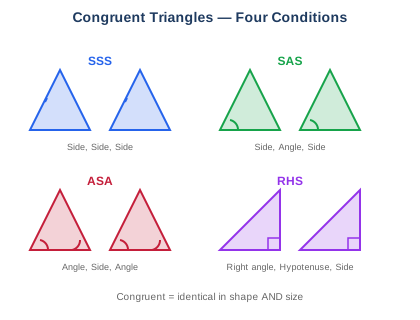
Two triangles are congruent if they satisfy one of these conditions:
| Condition | Meaning |
|---|---|
| SSS | All three Sides are equal |
| SAS | Two Sides and the Angle between them are equal |
| ASA | Two Angles and the Side between them are equal |
| RHS | Right angle, Hypotenuse, and one other Side are equal |
Similar Shapes
Shapes are similar if they are the same shape but different sizes.
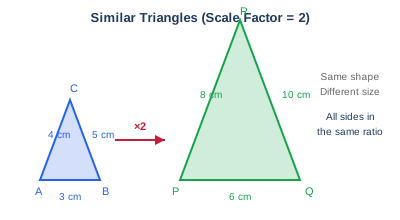
All corresponding angles are equal, and all corresponding sides are in the same ratio.
Scale Factor
$$\text{Scale factor} = \frac{\text{length on larger shape}}{\text{length on smaller shape}}$$
Finding Missing Lengths
If triangles are similar with scale factor $k$: $$\text{New length} = \text{Old length} \times k$$
Area and Volume Scale Factors
| Dimension | Scale Factor |
|---|---|
| Length | $k$ |
| Area | $k^2$ |
| Volume | $k^3$ |
Example: If lengths are in ratio 1:3 (SF = 3), then:
- Areas are in ratio 1:9 ($3^2$)
- Volumes are in ratio 1:27 ($3^3$)
Proving Triangles are Similar
Two triangles are similar if:
- AA: Two angles are equal (the third must also be equal)
- SSS: All three pairs of sides are in the same ratio
- SAS: Two pairs of sides in the same ratio AND the included angles equal
The Traps
Common misconceptions and how to avoid them.
Matching wrong corresponding sides "The Side Mismatch"
The Mistake in Action
Triangle ABC is similar to triangle PQR. AB = 4 cm, BC = 6 cm, PQ = 10 cm. Find QR.
Wrong: Scale factor = 10 ÷ 6 = 1.67, so QR = 4 × 1.67 = 6.67 cm
Why It Happens
Students pair up sides that look similar in length rather than sides in corresponding positions.
The Fix
In similar triangles, corresponding sides are opposite corresponding angles.
ABC ~ PQR means:
- A corresponds to P
- B corresponds to Q
- C corresponds to R
So AB corresponds to PQ (both opposite angle C/R). BC corresponds to QR (both opposite angle A/P).
Scale factor = $\frac{PQ}{AB} = \frac{10}{4} = 2.5$
QR = BC × 2.5 = 6 × 2.5 = 15 cm
Spot the Mistake
ABC ~ PQR, AB = 4, BC = 6, PQ = 10
SF = 10 ÷ 6 = 1.67
Click on the line that contains the error.
Thinking AAA proves congruence "The AAA Assumption"
The Mistake in Action
Two triangles have all three angles equal. Therefore they are congruent.
Wrong: ✓ Congruent (AAA)
Why It Happens
Students know that angles being equal is important and assume three equal angles is enough. They confuse the conditions for similarity with congruence.
The Fix
AAA proves SIMILARITY, not congruence!
If all angles are equal, the triangles are the same shape but could be different sizes.
Congruent means same shape AND same size. You need at least one side measurement:
- SSS (three sides)
- SAS (two sides and included angle)
- ASA (two angles and included side)
- RHS (right angle, hypotenuse, side)
AAA = Similar, not Congruent
Spot the Mistake
All three angles are equal
Therefore congruent (AAA)
Click on the line that contains the error.
Using length scale factor for area "The Area Scale Slip"
The Mistake in Action
Two similar shapes have lengths in ratio 1:3. Shape A has area 5 cm². Find the area of shape B.
Wrong: Area of B = 5 × 3 = 15 cm²
Why It Happens
Students know lengths multiply by the scale factor and assume the same applies to area.
The Fix
For similar shapes:
- Length scale factor = $k$
- Area scale factor = $k^2$
- Volume scale factor = $k^3$
Length ratio 1:3 means $k = 3$ Area ratio = $1:3^2 = 1:9$
$$\text{Area of B} = 5 \times 9 = 45 \text{ cm}^2$$
Memory aid: Area is 2D, so square the scale factor. Volume is 3D, so cube it.
Spot the Mistake
Lengths in ratio 1:3, Area A = 5 cm²
Area B = 5 × 3 = 15 cm²
Click on the line that contains the error.
The Deep Dive
Apply your knowledge with these exam-style problems.
Level 1: Fully Worked
Complete solutions with commentary on each step.
Question
In triangles ABC and DEF: AB = DE, BC = EF, and angle ABC = angle DEF. Prove the triangles are congruent, stating the condition used.
Solution
Given information:
- AB = DE (one pair of sides equal)
- BC = EF (another pair of sides equal)
- Angle ABC = angle DEF (the angles between these sides are equal)
Condition: This is SAS (Side-Angle-Side)
Two sides and the included angle (the angle between those two sides) are equal.
Conclusion: Triangle ABC is congruent to triangle DEF (SAS).
Answer: Congruent by SAS
Question
Triangles ABC and PQR are similar. AB = 5 cm, BC = 8 cm, AC = 7 cm. PQ = 15 cm. Find QR.
Solution
Step 1: Find the scale factor. AB corresponds to PQ. $$\text{Scale factor} = \frac{PQ}{AB} = \frac{15}{5} = 3$$
Step 2: Find QR. BC corresponds to QR. $$QR = BC \times 3 = 8 \times 3 = 24 \text{ cm}$$
Answer: QR = 24 cm
Check: We could also find PR = AC × 3 = 7 × 3 = 21 cm
Question
Two similar shapes have a length scale factor of 4. The smaller shape has an area of 12 cm². Find the area of the larger shape.
Solution
Key fact: For similar shapes: $$\text{Area scale factor} = (\text{Length scale factor})^2$$
Length scale factor = 4 Area scale factor = $4^2 = 16$
$$\text{Area of larger shape} = 12 \times 16 = 192 \text{ cm}^2$$
Answer: 192 cm²
Level 2: Scaffolded
Fill in the key steps.
Question
In the diagram, DE is parallel to BC. Prove that triangle ADE is similar to triangle ABC.
Level 3: Solo
Try it yourself!
Question
Two similar cylinders have heights 6 cm and 15 cm. The smaller cylinder has volume 72 cm³. Find the volume of the larger cylinder.
Show Solution
Step 1: Find the length scale factor. $$\text{Length SF} = \frac{15}{6} = 2.5$$
Step 2: Find the volume scale factor. $$\text{Volume SF} = (\text{Length SF})^3 = 2.5^3 = 15.625$$
Step 3: Find the volume. $$\text{Volume of larger} = 72 \times 15.625 = 1125 \text{ cm}^3$$
Answer: 1125 cm³
Question
Two similar shapes have areas 25 cm² and 64 cm². The smaller shape has a side of length 10 cm. Find the corresponding side of the larger shape.
Show Solution
Step 1: Find the area scale factor. $$\text{Area SF} = \frac{64}{25} = 2.56$$
Step 2: Find the length scale factor. $$\text{Length SF} = \sqrt{\text{Area SF}} = \sqrt{2.56} = 1.6$$
Step 3: Find the length. $$\text{Corresponding side} = 10 \times 1.6 = 16 \text{ cm}$$
Answer: 16 cm
Examiner's View
Mark allocation: Identifying similar/congruent: 1-2 marks. Finding lengths: 2-3 marks. Area/volume problems: 3-4 marks.
Common errors examiners see:
- Using length scale factor for area (instead of squaring)
- Matching wrong sides when finding scale factor
- Confusing similar and congruent
- Not stating which congruence condition applies
What gains marks:
- State the condition used (SSS, SAS, etc.)
- Show clear working for scale factor
- Match corresponding sides correctly
AQA Notes
AQA often asks you to prove triangles are similar before using similarity.