
Graphs of Non-Linear Functions
The Skill
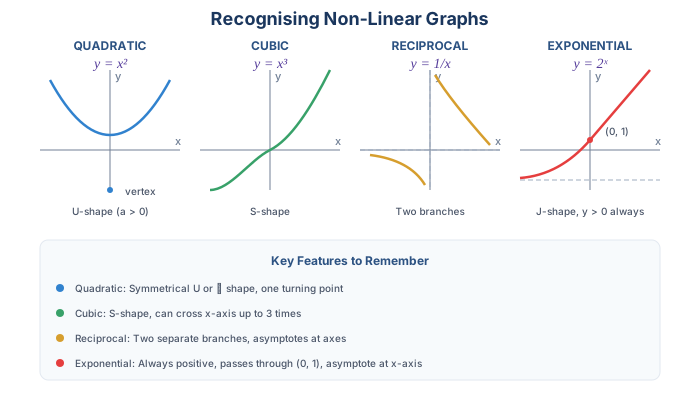
Non-linear graphs curve – they're not straight lines. Each type has a distinctive shape you should recognise.
Quadratic Graphs: $y = ax^2 + bx + c$
Shape: Parabola (U-shape or ∩-shape)
- If $a > 0$: U-shape (minimum point)
- If $a < 0$: ∩-shape (maximum point)
Key features:
- Roots/zeros: where the graph crosses the x-axis ($y = 0$)
- y-intercept: where the graph crosses the y-axis (the value of $c$)
- Turning point (vertex): the minimum or maximum point
- Line of symmetry: vertical line through the turning point
Finding the turning point: The x-coordinate is at $x = -\frac{b}{2a}$ Substitute this into the equation to find y.
Cubic Graphs: $y = ax^3 + bx^2 + cx + d$
Shape: S-curve or stretched S
- If $a > 0$: rises from bottom-left to top-right
- If $a < 0$: falls from top-left to bottom-right
Key features:
- Can have 1, 2, or 3 roots
- May have up to 2 turning points
- No line of symmetry (in general)
Reciprocal Graphs: $y = \frac{k}{x}$ or $y = \frac{k}{x^2}$
Shape: Hyperbola with two separate curves (branches)
For $y = \frac{k}{x}$:
- If $k > 0$: curves in quadrants 1 and 3
- If $k < 0$: curves in quadrants 2 and 4
Key features:
- Asymptotes: lines the graph approaches but never touches
- The x-axis and y-axis are asymptotes
- The graph never crosses either axis
Exponential Graphs: $y = a^x$ or $y = ka^x$
Shape: J-curve or reverse-J
For $y = a^x$ where $a > 1$:
- Starts very close to zero for negative x
- Rises steeply for positive x
- Always positive (never crosses x-axis)
- Passes through $(0, 1)$ since $a^0 = 1$
For growth/decay: $y = A(1 + r)^t$ or $y = A(1 - r)^t$
Plotting Non-Linear Graphs
- Create a table of values (x and y)
- Calculate y for each x value
- Plot each coordinate
- Join with a smooth curve (not straight line segments)
- Label the graph with its equation
Recognising Graph Types
The Traps
Common misconceptions and how to avoid them.
Joining plotted points with straight lines "The Connect-the-Dots"
The Mistake in Action
Student plots points for $y = x^2$ correctly at $(-2, 4), (-1, 1), (0, 0), (1, 1), (2, 4)$ but joins them with straight line segments.
Why It Happens
Students are used to joining points with rulers and forget that curved functions require smooth curves.
The Fix
For non-linear functions, always draw a smooth curve through the points.
- Use a steady hand or a flexicurve
- The curve should have no sudden corners or kinks
- The curve should pass through or very close to all plotted points
Quick check: Does your graph have the right shape?
- Quadratic: U or ∩
- Cubic: S-shape
- Reciprocal: Two separate curves
Spot the Mistake
Points plotted correctly
joined with straight lines
Click on the line that contains the error.
Placing the turning point at wrong coordinates "The Misplaced Vertex"
The Mistake in Action
For $y = x^2 - 4x + 3$, student states the minimum point is at $(0, 3)$.
Why It Happens
Students assume the turning point is at the y-intercept, or forget how to find the x-coordinate of the vertex.
The Fix
The turning point of $y = ax^2 + bx + c$ has x-coordinate: $$x = -\frac{b}{2a}$$
For $y = x^2 - 4x + 3$: $a = 1, b = -4$ $$x = -\frac{-4}{2(1)} = \frac{4}{2} = 2$$
Substitute to find y: $$y = (2)^2 - 4(2) + 3 = 4 - 8 + 3 = -1$$
Turning point: $(2, -1)$
Note: $(0, 3)$ is the y-intercept, not the vertex!
Spot the Mistake
$y = x^2 - 4x + 3$
minimum at $(0, 3)$
Click on the line that contains the error.
Drawing reciprocal graph through the origin "The Origin Error"
The Mistake in Action
Student draws $y = \frac{1}{x}$ passing through the origin.
Why It Happens
Students know graphs often pass through the origin and don't consider that division by zero is undefined.
The Fix
$y = \frac{1}{x}$ has asymptotes at the x-axis and y-axis.
When $x = 0$, the function is undefined (can't divide by zero).
The graph gets closer and closer to the axes but never touches or crosses them.
Draw asymptotes as dashed lines to show where the graph cannot go.
Spot the Mistake
Drawing $y = 1/x$
through the origin
Click on the line that contains the error.
Thinking exponential graphs cross the x-axis "The Impossible Intercept"
The Mistake in Action
Student draws $y = 2^x$ with an x-intercept at some negative value.
Why It Happens
Students see the curve getting very close to the x-axis and assume it eventually crosses.
The Fix
For $y = a^x$ where $a > 0$:
- $a^x$ is always positive (no matter what x is)
- The x-axis is an asymptote – the curve approaches but never reaches it
- When $x$ is very negative, $a^x$ is very small but still positive
Example: $2^{-10} = \frac{1}{1024} \approx 0.001$ (small but positive!)
The only way to get y = 0 would be if $2^x = 0$, which is impossible.
Spot the Mistake
$y = 2^x$
crosses the x-axis at negative x
Click on the line that contains the error.
The Deep Dive
Apply your knowledge with these exam-style problems.
Level 1: Fully Worked
Complete solutions with commentary on each step.
Question
Complete the table of values for $y = x^2 - 2x - 3$
| x | -2 | -1 | 0 | 1 | 2 | 3 | 4 |
|---|---|---|---|---|---|---|---|
| y |
Solution
Substitute each x value:
$x = -2$: $(-2)^2 - 2(-2) - 3 = 4 + 4 - 3 = 5$ $x = -1$: $(-1)^2 - 2(-1) - 3 = 1 + 2 - 3 = 0$ $x = 0$: $(0)^2 - 2(0) - 3 = 0 - 0 - 3 = -3$ $x = 1$: $(1)^2 - 2(1) - 3 = 1 - 2 - 3 = -4$ $x = 2$: $(2)^2 - 2(2) - 3 = 4 - 4 - 3 = -3$ $x = 3$: $(3)^2 - 2(3) - 3 = 9 - 6 - 3 = 0$ $x = 4$: $(4)^2 - 2(4) - 3 = 16 - 8 - 3 = 5$
| x | -2 | -1 | 0 | 1 | 2 | 3 | 4 |
|---|---|---|---|---|---|---|---|
| y | 5 | 0 | -3 | -4 | -3 | 0 | 5 |
Question
Find the coordinates of the turning point of $y = x^2 - 6x + 5$
Solution
Method 1: Using the formula
For $y = ax^2 + bx + c$, the turning point has x-coordinate: $$x = -\frac{b}{2a} = -\frac{-6}{2(1)} = \frac{6}{2} = 3$$
Substitute $x = 3$ into the equation: $$y = (3)^2 - 6(3) + 5 = 9 - 18 + 5 = -4$$
Turning point: (3, -4)
Since $a = 1 > 0$, this is a minimum point.
Method 2: Completing the square $y = x^2 - 6x + 5 = (x - 3)^2 - 9 + 5 = (x - 3)^2 - 4$
Minimum when $(x - 3)^2 = 0$, i.e., $x = 3$, giving $y = -4$
Question
Sketch the graph of $y = \frac{2}{x}$, showing any asymptotes.
Solution
Key features of $y = \frac{2}{x}$:
- Asymptotes: The x-axis ($y = 0$) and y-axis ($x = 0$) are asymptotes.
- Shape: Since the coefficient (2) is positive, the curves are in quadrants 1 and 3.
- Key points:
- When $x = 1$: $y = 2$
- When $x = 2$: $y = 1$
- When $x = -1$: $y = -2$
- When $x = -2$: $y = -1$
- Sketch: Draw two separate curved branches, one in the top-right quadrant (approaching both axes), one in the bottom-left quadrant.
Remember: The graph never touches or crosses the axes.
Level 2: Scaffolded
Fill in the key steps.
Question
For the graph of $y = -x^2 + 4x - 3$, find: (a) the y-intercept (b) the x-coordinate of the turning point (c) whether the turning point is a maximum or minimum
Level 3: Solo
Try it yourself!
Question
The graph of $y = x^2 - 3$ is drawn. Use the graph to solve $x^2 - 3 = 1$.
Show Solution
Method: The solutions to $x^2 - 3 = 1$ are where $y = 1$.
Draw a horizontal line at $y = 1$ and find where it crosses the parabola.
Algebraic check: $x^2 - 3 = 1$ $x^2 = 4$ $x = \pm 2$
Answer: $x = -2$ or $x = 2$
On the graph, you would see the horizontal line $y = 1$ crossing the parabola at $(-2, 1)$ and $(2, 1)$.
Question
Sketch the graph of $y = 3^x$, labelling key features.
Show Solution
Key features of $y = 3^x$:
- y-intercept: When $x = 0$: $y = 3^0 = 1$
Point: $(0, 1)$
- Asymptote: The x-axis ($y = 0$) is a horizontal asymptote as $x \to -\infty$
- Shape: J-curve rising steeply for positive x
- Other points:
- $x = 1$: $y = 3$
- $x = 2$: $y = 9$
- $x = -1$: $y = \frac{1}{3}$
- Sketch: Start very close to x-axis on the left, pass through $(0, 1)$, then rise steeply to the right.
The curve is always above the x-axis (y is always positive).
Examiner's View
Mark allocation: Plotting from a table is 2-3 marks. Sketching from an equation is 2-3 marks. Finding features (roots, turning point) is 2-4 marks.
Common errors examiners see:
- Joining points with straight lines instead of a smooth curve
- Missing the y-intercept or roots
- Drawing asymptotes as lines the graph crosses
- Incorrect turning point location
What gains marks:
- Smooth, continuous curves
- Key points labelled (intercepts, turning point)
- Asymptotes shown as dashed lines
- Correct shape for the function type
AQA Notes
AQA may give you a table to complete and then plot. Check your calculations carefully.