
Histograms H
The Skill
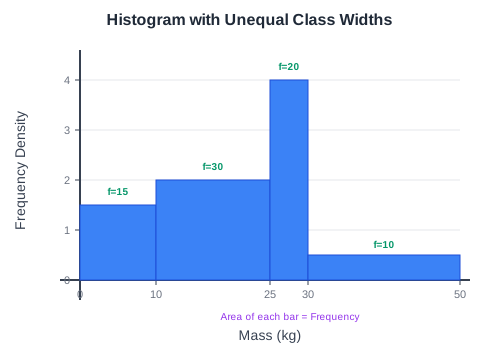
A histogram displays continuous data with bars where area represents frequency, not height. This makes histograms different from bar charts.
Why Histograms?
When class widths are unequal, using bar heights for frequency would be misleading. Instead, we use frequency density so that area = frequency.
The Key Formula
$$\text{Frequency Density} = \frac{\text{Frequency}}{\text{Class Width}}$$
Rearranging: $$\text{Frequency} = \text{Frequency Density} \times \text{Class Width}$$
This means: Frequency = Area of bar
Drawing a Histogram
- Calculate the class width for each class
- Calculate the frequency density for each class
- Draw bars with:
- Width = class width
- Height = frequency density
- No gaps between bars (continuous data)
- Label the y-axis as "Frequency Density"
Example Calculation Table
| Mass (kg) | Class Width | Frequency | Frequency Density |
|---|---|---|---|
| 0 ≤ m < 10 | 10 | 15 | $15 ÷ 10 = 1.5$ |
| 10 ≤ m < 25 | 15 | 30 | $30 ÷ 15 = 2$ |
| 25 ≤ m < 30 | 5 | 20 | $20 ÷ 5 = 4$ |
| 30 ≤ m < 50 | 20 | 10 | $10 ÷ 20 = 0.5$ |
Reading a Histogram
To find the frequency from a histogram:
- Find the width of the bar (read from x-axis)
- Find the height of the bar (read from y-axis = frequency density)
- Calculate: Frequency = Width × Height
Finding Totals and Estimates
Total frequency: Add up the areas of all bars.
Estimate of values in a range: Calculate the area of the bars (or parts of bars) that fall within the range.
Class Boundaries
Watch out for how classes are written:
- "10 to 20" or "10-20" usually means 10 ≤ x < 20
- Check whether boundaries overlap — in a histogram, each value should belong to exactly one class
The Traps
Common misconceptions and how to avoid them.
Using frequency for the height instead of frequency density "The Height Mistake"
The Mistake in Action
Draw a histogram for this data:
| Height (cm) | Frequency |
|---|---|
| 140-150 | 12 |
| 150-160 | 18 |
| 160-180 | 24 |
Wrong: Student draws bars with heights 12, 18, and 24.
Why It Happens
Students treat histograms like bar charts, using frequency directly for height.
The Fix
In a histogram, area = frequency, not height.
Calculate frequency density: $$\text{FD} = \frac{\text{Frequency}}{\text{Class Width}}$$
| Height | Width | Frequency | FD |
|---|---|---|---|
| 140-150 | 10 | 12 | $12 ÷ 10 = 1.2$ |
| 150-160 | 10 | 18 | $18 ÷ 10 = 1.8$ |
| 160-180 | 20 | 24 | $24 ÷ 20 = 1.2$ |
The third bar should be the same height as the first (both 1.2), but twice as wide.
If you used frequency for height, the 160-180 bar would look like it represents more data, when actually 140-150 and 160-180 have the same frequency density!
Spot the Mistake
Drawing bars with heights 12, 18, and 24
Click on the line that contains the error.
Reading the height instead of calculating the area "The Reading Error"
The Mistake in Action
From the histogram, find the frequency for the class 20 ≤ x < 50.
The bar for this class has height 4 on the frequency density axis.
Wrong: Frequency = 4
Why It Happens
Students read the height value directly, forgetting that histograms represent frequency through area.
The Fix
In a histogram: Frequency = Area of bar = Width × Height
The bar has:
- Width = $50 - 20 = 30$
- Height (frequency density) = 4
$$\text{Frequency} = 30 \times 4 = 120$$
Always remember: The y-axis shows frequency density, not frequency. You must multiply by the class width to get the actual frequency.
Spot the Mistake
Bar height is 4
Frequency = 4
Click on the line that contains the error.
Calculating the wrong class width "The Width Blunder"
The Mistake in Action
Calculate the frequency density for this class: Mass: 50 ≤ m < 75, Frequency: 20
Wrong: Width = 75 + 50 = 125 FD = $20 ÷ 125 = 0.16$
Why It Happens
Students add the boundaries instead of subtracting, or make errors reading the class boundaries.
The Fix
Class width = Upper boundary − Lower boundary
For the class 50 ≤ m < 75: $$\text{Width} = 75 - 50 = 25$$ $$\text{FD} = \frac{20}{25} = 0.8$$
Watch out for different notations:
- "50-75" usually means 50 ≤ m < 75 (width = 25)
- "50-" followed by "75-" means the classes are 50 ≤ m < 75 and 75 ≤ m < (next value)
Spot the Mistake
Mass: 50 ≤ m < 75, Frequency: 20
Width = 75 + 50 = 125
Click on the line that contains the error.
Leaving gaps between histogram bars "The Gap Problem"
The Mistake in Action
Student draws a histogram with gaps between each bar, like a bar chart.
Why It Happens
Bar charts for categorical data have gaps; students apply the same style to histograms.
The Fix
Histograms represent continuous data — there are no gaps between classes.
- Bar charts: Discrete/categorical data → gaps between bars
- Histograms: Continuous data → no gaps between bars
The bars in a histogram touch because one class ends exactly where the next begins (e.g., 10 ≤ x < 20 is followed by 20 ≤ x < 30).
If there genuinely is a gap in the data (e.g., no values between 30 and 50), the histogram simply has no bar in that region — but adjacent classes still touch.
Spot the Mistake
Drawing a histogram
with gaps between bars
Click on the line that contains the error.
The Deep Dive
Apply your knowledge with these exam-style problems.
Level 1: Fully Worked
Complete solutions with commentary on each step.
Question
Calculate the frequency density for each class and complete the table.
| Time (seconds) | Frequency |
|---|---|
| 0 ≤ t < 10 | 15 |
| 10 ≤ t < 25 | 45 |
| 25 ≤ t < 30 | 35 |
| 30 ≤ t < 50 | 20 |
Solution
Formula: Frequency Density = Frequency ÷ Class Width
| Time | Class Width | Frequency | FD |
|---|---|---|---|
| 0 ≤ t < 10 | 10 | 15 | $15 ÷ 10 = 1.5$ |
| 10 ≤ t < 25 | 15 | 45 | $45 ÷ 15 = 3$ |
| 25 ≤ t < 30 | 5 | 35 | $35 ÷ 5 = 7$ |
| 30 ≤ t < 50 | 20 | 20 | $20 ÷ 20 = 1$ |
Notice:
- The 25-30 class has the highest frequency density (7) despite not having the highest frequency
- This is because it has a narrow class width (only 5 seconds)
- On the histogram, this bar would be tall but thin
Answer: FD values are 1.5, 3, 7, and 1
Question
Draw a histogram for this data:
| Height (cm) | Frequency |
|---|---|
| 100 ≤ h < 120 | 16 |
| 120 ≤ h < 130 | 25 |
| 130 ≤ h < 150 | 30 |
Solution
Step 1: Calculate class widths and frequency densities.
| Height | Width | Frequency | FD |
|---|---|---|---|
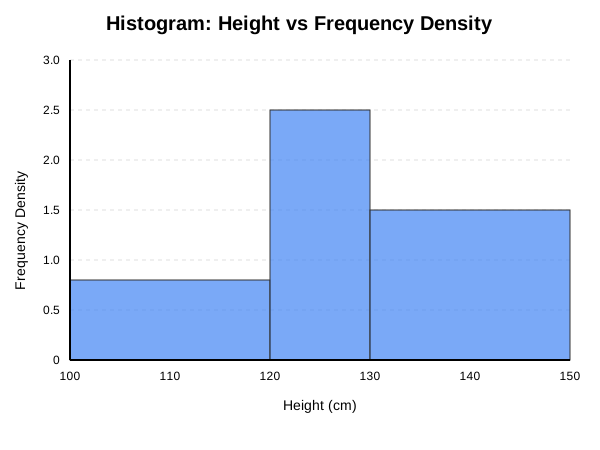
| 100-120 | 20 | 16 | $16 ÷ 20 = 0.8$ |
| 120-130 | 10 | 25 | $25 ÷ 10 = 2.5$ |
| 130-150 | 20 | 30 | $30 ÷ 20 = 1.5$ |
Step 2: Set up your axes.
- x-axis: Height (cm), from 100 to 150
- y-axis: Frequency Density, from 0 to at least 2.5
Step 3: Draw the bars.
- Bar 1: x from 100 to 120 (width 20), height 0.8
- Bar 2: x from 120 to 130 (width 10), height 2.5
- Bar 3: x from 130 to 150 (width 20), height 1.5
Key points:
- No gaps between bars
- Label y-axis "Frequency Density"
- Bars touch at class boundaries
Question
The table shows waiting times at a clinic. Some of the histogram has been drawn.
| Time (mins) | Frequency | FD |
|---|---|---|
| 0 ≤ t < 5 | 20 | ? |
| 5 ≤ t < 10 | ? | 6 |
| 10 ≤ t < 30 | 50 | ? |
The bar for 5 ≤ t < 10 is already drawn with height 6.
a) Find the missing frequency for 5 ≤ t < 10.
b) Find the frequency density for the other classes.
c) Complete the histogram.
Solution
a) Finding the missing frequency: Width of 5 ≤ t < 10 is $10 - 5 = 5$ Frequency = Width × FD = $5 × 6 = 30$
b) Finding the missing frequency densities: For 0 ≤ t < 5: Width = 5 FD = $20 ÷ 5 = 4$
For 10 ≤ t < 30: Width = 20 FD = $50 ÷ 20 = 2.5$
c) Drawing the remaining bars:
- Bar for 0-5: height 4, width 5
- Bar for 10-30: height 2.5, width 20
Answers: a) Frequency = 30 b) FD for 0-5 is 4; FD for 10-30 is 2.5
Level 2: Scaffolded
Fill in the key steps.
Question
The histogram shows the ages of people at a gym.
The bar for 20 ≤ age < 30 has height 4.5 on the frequency density axis. The bar for 30 ≤ age < 50 has height 2.5 on the frequency density axis.
Find the total number of people in these two age groups.
Level 3: Solo
Try it yourself!
Question
A histogram shows the times taken to complete a puzzle.
| Time (mins) | 0-2 | 2-5 | 5-10 | 10-20 |
|---|---|---|---|---|
| FD | 3 | 8 | 4 | 1.5 |
a) How many people completed the puzzle in under 5 minutes? b) Estimate how many people took between 6 and 15 minutes.
Show Solution
a) Under 5 minutes: 0-2: Frequency = $2 × 3 = 6$ 2-5: Frequency = $3 × 8 = 24$ Total under 5 mins = $6 + 24 = 30$
b) Between 6 and 15 minutes: We need parts of the 5-10 and 10-20 classes.
From 6 to 10 (within the 5-10 class): Width of this portion = 4 Frequency = $4 × 4 = 16$
From 10 to 15 (within the 10-20 class): Width of this portion = 5 Frequency = $5 × 1.5 = 7.5$
Estimate for 6-15 mins = $16 + 7.5 = 23.5 ≈ 24$ people
Answers: a) 30 people b) Approximately 24 people
Examiner's View
Mark allocation: Drawing a histogram is typically 3-4 marks. Reading a histogram is 2-3 marks. Estimating values from a histogram is 2-3 marks.
Common errors examiners see:
- Using frequency instead of frequency density for the height
- Leaving gaps between bars (histograms have no gaps)
- Incorrect class widths (especially with boundaries like 0-5, 5-10)
- Reading height when asked for frequency (forgetting to multiply by width)
- Labelling the y-axis as "Frequency" instead of "Frequency Density"
What gains marks:
- Showing the frequency density calculation
- Correct axis labels
- Accurate bar widths and heights
- A clear frequency density table in your working
AQA Notes
AQA often provides a partially completed histogram and asks you to complete it, or gives you the histogram and asks for estimates.