

Error Intervals and Bounds H
The Skill
When a number is rounded, the original value lies within a range called the error interval. The endpoints of this range are called bounds.
Understanding Bounds
When a measurement is given as a rounded value, the actual value could be anything that rounds to that number.
Example: A length is 5.3 cm (to 1 decimal place)
The smallest it could be: 5.25 cm (this would round up to 5.3) The largest it could be: just under 5.35 cm (5.35 would round up to 5.4)
Lower bound (LB): 5.25 cm Upper bound (UB): 5.35 cm
Writing Error Intervals
The error interval uses inequalities:
$$5.25 \leq x < 5.35$$
Note: We use $<$ for the upper bound because the actual value must be less than 5.35 (not equal to it).
Finding Bounds for Different Degrees of Accuracy
| Rounded to | Lower bound is | Upper bound is |
|---|---|---|
| Nearest integer | Value − 0.5 | Value + 0.5 |
| 1 d.p. | Value − 0.05 | Value + 0.05 |
| 2 d.p. | Value − 0.005 | Value + 0.005 |
| Nearest 10 | Value − 5 | Value + 5 |
| Nearest 100 | Value − 50 | Value + 50 |
Truncation
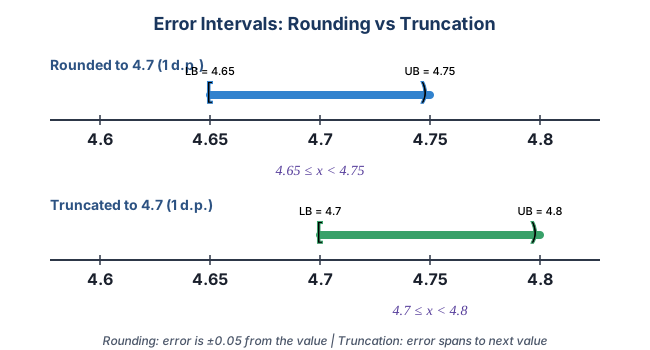
Truncation means cutting off digits (not rounding). For truncated values:
Example: 4.7 is the result of truncating to 1 d.p.
Lower bound: 4.7 (could be exactly 4.7) Upper bound: 4.8 (but not equal to 4.8)
$$4.7 \leq x < 4.8$$
Calculations with Bounds
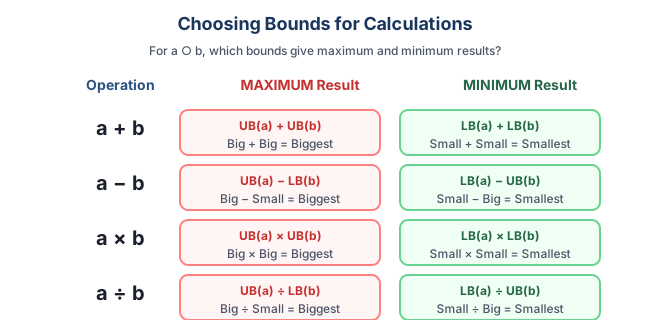
To find the bounds of a calculation, think about what gives the biggest/smallest answer:
For maximum results:
- Addition: use UB + UB
- Subtraction: use UB − LB
- Multiplication: use UB × UB
- Division: use UB ÷ LB
For minimum results:
- Addition: use LB + LB
- Subtraction: use LB − UB
- Multiplication: use LB × LB
- Division: use LB ÷ UB
Example: A rectangle has length 8.4 cm and width 3.2 cm (both to 1 d.p.). Find the bounds of the area.
LB of length = 8.35, UB of length = 8.45 LB of width = 3.15, UB of width = 3.25
Minimum area = $8.35 \times 3.15 = 26.3025$ cm² Maximum area = $8.45 \times 3.25 = 27.4625$ cm²
Rounding vs Truncation Visualised
Bounds for Operations
The Traps
Common misconceptions and how to avoid them.
Using the wrong inequality sign for upper bound "The Inequality Slip"
The Mistake in Action
A length is 4.7 m to 1 decimal place. Write the error interval.
Wrong: $4.65 \leq x \leq 4.75$
Why It Happens
Students use ≤ for both bounds, not realising the upper bound itself would round UP, not to the given value.
The Fix
The upper bound uses $<$ (strict inequality) because the actual value must be less than the upper bound.
$4.75$ would round to $4.8$, not $4.7$.
Correct error interval: $4.65 \leq x < 4.75$
Remember:
- Lower bound: $\leq$ (can equal this value)
- Upper bound: $<$ (must be less than this value)
Spot the Mistake
$4.65 \leq x$
$\leq 4.75$
Click on the line that contains the error.
Using wrong bounds for subtraction "The Subtraction Swap"
The Mistake in Action
Find the minimum value of $a - b$ where $a = 8.5$ and $b = 3.2$ (both to 1 d.p.).
Wrong: Minimum = $8.45 - 3.15 = 5.30$
Why It Happens
Students use LB − LB for minimum, not realising that subtracting a smaller number gives a larger result.
The Fix
For minimum of $a - b$:
- Use smallest $a$ → LB of $a$
- Use largest $b$ → UB of $b$
Minimum = LB(a) − UB(b) = $8.45 - 3.25 = 5.20$
Think about it: To get the smallest difference, make the first number as small as possible and the second as large as possible.
Spot the Mistake
Minimum of $a - b$
$= 8.45 - 3.15 = 5.30$
Click on the line that contains the error.
Treating truncation the same as rounding "The Truncation Trap"
The Mistake in Action
A number is truncated to 3.4 (1 d.p.). Write the error interval.
Wrong: $3.35 \leq x < 3.45$
Why It Happens
Students apply rounding rules, forgetting that truncation just "chops off" digits without considering what comes next.
The Fix
Truncation means cutting off – the number could have been anything from 3.4 up to (but not including) 3.5.
For truncation to 3.4:
- Lower bound: 3.4 (could be exactly 3.4)
- Upper bound: 3.5 (3.49999... would truncate to 3.4)
Error interval: $3.4 \leq x < 3.5$
Key difference:
- Rounding to 3.4: $3.35 \leq x < 3.45$
- Truncating to 3.4: $3.4 \leq x < 3.5$
Spot the Mistake
Truncated to 3.4
$3.35 \leq x < 3.45$
Click on the line that contains the error.
Adding/subtracting wrong amount for bounds "The Half-Step Slip"
The Mistake in Action
A mass is 250g to the nearest 10g. Find the bounds.
Wrong: LB = $250 - 10 = 240$g, UB = $250 + 10 = 260$g
Why It Happens
Students subtract/add the whole rounding interval instead of half of it.
The Fix
The error is half the degree of accuracy.
For rounding to nearest 10:
- LB = $250 - 5 = 245$g
- UB = $250 + 5 = 255$g
Why half? Values from 245 to 254.999... all round to 250.
| Degree of accuracy | Error is |
|---|---|
| Nearest 10 | ±5 |
| Nearest 100 | ±50 |
| Nearest integer | ±0.5 |
| 1 d.p. | ±0.05 |
Spot the Mistake
250g to nearest 10g
LB = $250 - 10 = 240$g
Click on the line that contains the error.
The Deep Dive
Apply your knowledge with these exam-style problems.
Level 1: Fully Worked
Complete solutions with commentary on each step.
Question
A length is measured as 7.3 cm to 1 decimal place. Write the error interval.
Solution
Step 1: Identify the degree of accuracy. Rounded to 1 decimal place.
Step 2: Find half of the smallest unit. $\frac{0.1}{2} = 0.05$
Step 3: Calculate the bounds.
- Lower bound: $7.3 - 0.05 = 7.25$
- Upper bound: $7.3 + 0.05 = 7.35$
Step 4: Write the error interval with correct inequality signs. $$7.25 \leq x < 7.35$$
Answer: $7.25 \leq x < 7.35$
Question
A mass is given as 450 g to the nearest 10 g. Write the error interval.
Solution
Step 1: Identify the degree of accuracy. Rounded to nearest 10.
Step 2: Find half of the smallest unit. $\frac{10}{2} = 5$
Step 3: Calculate the bounds.
- Lower bound: $450 - 5 = 445$
- Upper bound: $450 + 5 = 455$
Step 4: Write the error interval. $$445 \leq m < 455$$
Answer: $445 \leq m < 455$ g
Question
A rectangle has length 8.4 cm and width 5.7 cm, both measured to 1 decimal place. Calculate the upper and lower bounds of the area.
Solution
Step 1: Find bounds for each measurement. Length: $8.35 \leq l < 8.45$ Width: $5.65 \leq w < 5.75$
Step 2: For maximum area, use UB × UB. $$\text{Maximum area} = 8.45 \times 5.75 = 48.5875 \text{ cm}^2$$
Step 3: For minimum area, use LB × LB. $$\text{Minimum area} = 8.35 \times 5.65 = 47.1775 \text{ cm}^2$$
Answer:
- Lower bound: 47.1775 cm² (or 47.18 cm² to 2 d.p.)
- Upper bound: 48.5875 cm² (or 48.59 cm² to 2 d.p.)
Level 2: Scaffolded
Fill in the key steps.
Question
Distance = 126 km (to 3 s.f.), Time = 2.4 hours (to 1 d.p.). Find the maximum possible speed.
Level 3: Solo
Try it yourself!
Question
A number is truncated to 2.8 (to 1 d.p.). Write the error interval.
Show Solution
Truncation means cutting off digits, not rounding.
Any value from 2.8 up to (but not including) 2.9 would truncate to 2.8.
- Lower bound: 2.8 (could be exactly 2.8)
- Upper bound: 2.9 (2.89999... would truncate to 2.8, but 2.9 would truncate to 2.9)
Error interval: $2.8 \leq x < 2.9$
Compare to rounding: If 2.8 was rounded (not truncated), the interval would be $2.75 \leq x < 2.85$
Question
The error interval for a length is $12.5 \leq x < 13.5$. To what accuracy was the length given?
Show Solution
Step 1: Find the range of the interval. $13.5 - 12.5 = 1$
Step 2: The degree of accuracy is the range. Since the range is 1, the measurement was given to the nearest 1 unit (or nearest integer).
Step 3: Verify by finding the middle. $\frac{12.5 + 13.5}{2} = 13$
Answer: The length was 13 units, given to the nearest integer (or nearest whole number).
Alternative phrasing: The length is 13 to 2 significant figures.
Examiner's View
Mark allocation: Finding bounds is 2 marks. Calculations with bounds is 3-4 marks.
Common errors examiners see:
- Using the wrong inequality sign ($\leq$ vs $<$)
- Adding instead of subtracting for bounds
- Using the wrong combination for calculations
- Rounding the final bounds (usually not wanted)
What gains marks:
- State which bounds you're using and why
- Show the calculation clearly
- Give exact answers unless told to round
- Double-check the inequality direction
AQA Notes
AQA often asks for error intervals in the form $a \leq x < b$. Make sure to use correct inequality symbols.