

Time Management in Exams
Making Every Minute Count
Time pressure causes more lost marks than lack of knowledge. Learn to manage your time strategically.
The Basic Calculation
GCSE Maths papers are roughly 1 mark per minute
| Paper Type | Typical Time | Typical Marks | Time per Mark |
|---|---|---|---|
| Foundation | 90 mins | 80 marks | ~1 min 7 secs |
| Higher | 90 mins | 80 marks | ~1 min 7 secs |
This means:
- A 3-mark question should take ~3 minutes
- A 5-mark question should take ~5 minutes
- Leave time for checking at the end
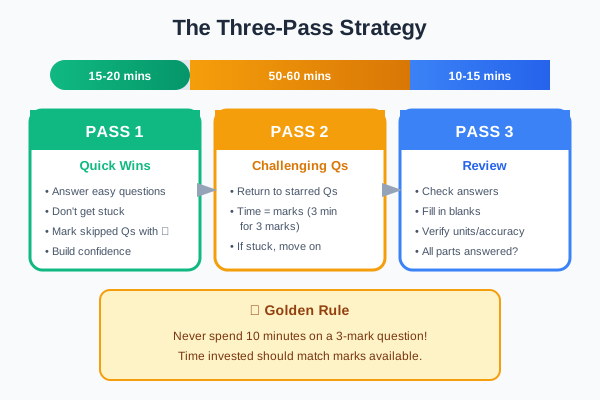
The Three-Pass Strategy
Pass 1: Quick Wins (First 15-20 minutes)
- Answer every question you can do quickly
- Don't get stuck — move on
- Mark skipped questions with a star ★
Pass 2: Challenging Questions (Next 50-60 minutes)
- Return to starred questions
- Spend appropriate time based on marks
- If completely stuck after 3-4 minutes, move on
Pass 3: Review (Final 10-15 minutes)
- Check your answers make sense
- Fill in any remaining blanks
- Verify you've answered every part
Reading Time
Use the first few minutes wisely:
- Skim the whole paper — see what's coming
- Identify your strengths — what can you do quickly?
- Spot the big questions — where are the most marks?
- Note any unusual question types — anything you haven't seen before?
Time Traps to Avoid
The Perfectionist Trap: Don't spend 10 minutes perfecting a 2-mark answer. Get the marks and move on.
The Sunk Cost Trap: If you've spent 5 minutes on a 3-mark question with no progress, leave it. You've already "paid" the time — don't keep paying.
The Easy Question Trap: Students often rush through easy questions, make silly errors, and lose marks. Easy marks are still marks.
The Last Question Trap: The final question isn't always the hardest. Don't panic if you reach it with time to spare.
Mark Allocation Strategy
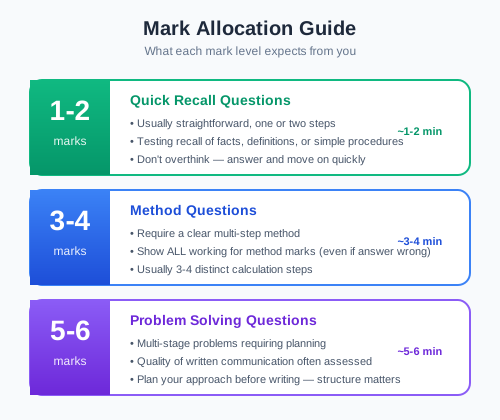
1-2 mark questions:
- Usually straightforward
- Often one or two steps
- Don't overthink — they're testing recall, not problem-solving
3-4 mark questions:
- Require a clear method
- Show all working for method marks
- Usually 3-4 distinct steps
5-6 mark questions:
- Problem-solving or multi-stage
- Plan your approach before writing
- Quality of communication matters
When You're Running Out of Time
If you have 10 minutes left and several questions unanswered:
- Prioritise by confidence — do what you can do first
- Write something on every question — never leave blanks
- Focus on method marks — even writing the formula earns marks
- Make educated guesses on multiple choice — there's no negative marking
Building Time Awareness
During revision:
- Time yourself on practice papers
- Note which topics slow you down
- Practice those topics more
In the exam:
- Check the clock after every 5-6 questions
- Know the halfway point (45 mins) — you should be halfway through marks
- If you're behind, speed up by being more concise