
Checking Your Answers
Quality Control
Checking isn't about reading through your work hoping it looks right. It's about using mathematical strategies to verify your answers are correct.
Inverse Operation Checks
Whatever mathematical operation you did, do the opposite to check:
Addition ↔ Subtraction You calculated: $847 + 256 = 1103$ Check: $1103 - 256 = 847$ ✓
Multiplication ↔ Division You calculated: $23 \times 47 = 1081$ Check: $1081 \div 47 = 23$ ✓
Powers ↔ Roots You calculated: $7^3 = 343$ Check: $\sqrt[3]{343} = 7$ ✓
Substitution Checks for Algebra
Always substitute your answer back into the original equation:
If you solved $3x + 7 = 22$ and got $x = 5$: Check: $3(5) + 7 = 15 + 7 = 22$ ✓
If you solved $x^2 - 5x + 6 = 0$ and got $x = 2$ or $x = 3$: Check $x = 2$: $(2)^2 - 5(2) + 6 = 4 - 10 + 6 = 0$ ✓ Check $x = 3$: $(3)^2 - 5(3) + 6 = 9 - 15 + 6 = 0$ ✓
Estimation Checks
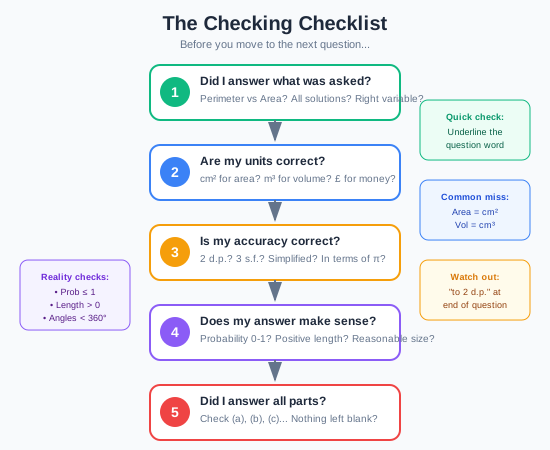
Before accepting any answer, ask: Is this reasonable?
Example 1: You calculate that a car travels 5000 km in 2 hours. Reality check: That's 2500 km/h — faster than a commercial jet! Something's wrong.
Example 2: You calculate the area of a room as 0.24 m². Reality check: That's smaller than a sheet of paper! You probably forgot to convert units.
Example 3: You calculate a probability as 1.5. Reality check: Probability must be between 0 and 1. Error!
Unit Checks
Units can reveal errors:
Consistent units?
- All lengths in the same unit before calculating
- Time in hours if speed is in km/h
Sensible units?
- Area should be square units (cm², m²)
- Volume should be cubic units (cm³, m³)
Final answer units?
- Did you give what the question asked?
- Did you convert if required?
Geometry Checks
Angles in shapes:
- Triangle angles sum to 180°
- Quadrilateral angles sum to 360°
- Angles on a straight line sum to 180°
If your calculated angles don't follow these rules, you've made an error.
Length checks:
- The longest side of a triangle is opposite the largest angle
- The hypotenuse is always the longest side of a right-angled triangle
- No side of a triangle can be longer than the sum of the other two
Statistics Checks
Mean: The mean should be between the minimum and maximum values in your data set.
Probability:
- Must be between 0 and 1
- All probabilities for an event must sum to 1
- P(not A) = 1 - P(A)
Grouped data: Your answer should be within the range of possible values, not outside the data set.
Common Calculator Errors to Catch
Bracket errors: $12 \div 4 + 2$ is very different from $12 \div (4 + 2)$
Negative number errors: $(-3)^2 = 9$ but $-3^2 = -9$
Order of operations: Check your calculator is interpreting your input correctly
The Final 5 Minutes
In the last 5 minutes of the exam:
- Haven't checked anything? Prioritise high-mark questions
- Any blank answers? Write something — anything
- Silly mistakes? Scan for obvious errors (negative areas, probabilities > 1)
- Units missing? Quick check through circled answers
- Name on the paper? Don't forget!