

The Science of Learning
Your brain isn't broken — it's designed to forget. Here's how to work with it, not against it.
Ever had this experience? You revise something, feel confident you know it, then a week later it's just... gone?
That's not a flaw in your brain. That's your brain working exactly as designed. And once you understand why, you can use it to your advantage.
The Forgetting Curve: Why You Forget (And That's Normal)
In the 1880s, a German psychologist named Hermann Ebbinghaus did something slightly mad: he memorised thousands of nonsense syllables and tracked exactly how quickly he forgot them.
What he discovered was the forgetting curve — and it explains a lot about why revision feels so frustrating.
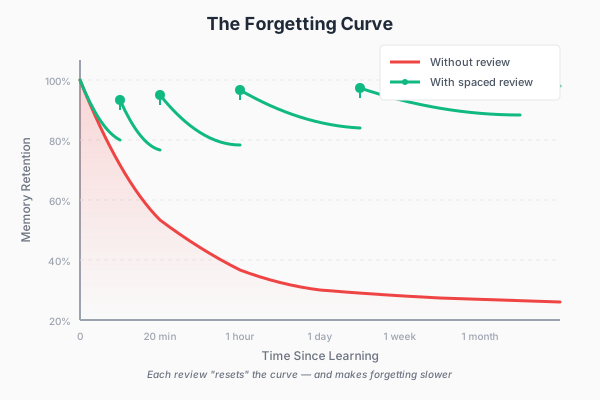
Here's the pattern:
- After 20 minutes: You've already forgotten about 40% of what you just learned
- After 1 day: You've forgotten about 70%
- After 1 week: You've forgotten about 80%
- After 1 month: Almost everything is gone
This sounds depressing, but it's actually useful information. Your brain is designed to forget things it doesn't use — otherwise you'd remember every single thing that ever happened to you (which would be overwhelming and useless).
The key insight: every time you successfully recall something, you flatten the forgetting curve. The memory decays more slowly. Do this enough times, at the right intervals, and the information moves into long-term storage.
This is the science behind spaced repetition — and why cramming the night before is such a terrible strategy.
Why Cramming Fails (Even When It Feels Great)
Here's a cruel trick your brain plays on you:
When you cram information right before a test, it sits in your short-term memory. You can access it easily, it feels familiar, and you might even do okay on tomorrow's test.
But short-term memory is like a whiteboard — it gets wiped quickly. Within days, most of what you crammed is gone. Completely.
This is why students who cram can pass individual tests but bomb their GCSEs. The exams test everything from two years of study. If you only ever crammed, none of that knowledge is in long-term storage.
The illusion of learning: Cramming feels effective because the material is fresh and familiar. But familiarity isn't the same as learning. Being able to recognise something ("oh yeah, I remember seeing this") is completely different from being able to produce it under exam conditions.
Storage Strength vs Retrieval Strength
Memory researchers talk about two different "strengths" for any memory:
Storage strength = How deeply embedded the memory is Retrieval strength = How easily you can access it right now
Here's the counterintuitive bit: these don't always match up.
Something can have high storage strength (it's in there somewhere) but low retrieval strength (you can't access it right now). This is the "it's on the tip of my tongue" feeling.
The critical insight: retrieval strength fades with time, but every time you successfully retrieve something, both strengths increase.
This is why testing yourself is so much more effective than re-reading. Re-reading builds a bit of storage strength but does almost nothing for retrieval strength. Testing yourself — especially when it's difficult — builds both.
Why Struggle Makes You Smarter
This brings us to a concept called desirable difficulty.
When learning feels easy, you're probably not learning much. When it feels hard — when you're struggling to remember something, when you're not sure which method to use, when you get things wrong — that's when the real learning happens.
Your brain is like a muscle. It doesn't get stronger by doing easy things; it gets stronger by being challenged. The mental effort of struggling to recall something, or figuring out which approach to use, creates stronger neural connections.
This is deeply counterintuitive because:
- Easy revision feels productive
- Difficult revision feels frustrating
- But difficult revision is actually productive, and easy revision is often a waste of time
What this means for your revision:
- If you're breezing through practice questions, they're too easy — find harder ones
- If you're looking at your notes while practising, you're robbing yourself of the struggle that builds memory
- If a revision session feels comfortable, you're probably not learning as much as you could be
Blocked vs Interleaved Practice: The Maths Game-Changer
This one is particularly important for maths revision.
Blocked practice is when you do lots of the same type of problem in a row:
- 20 questions on Pythagoras
- Then 20 questions on area
- Then 20 questions on percentages
Interleaved practice is when you mix them up:
- A Pythagoras question, then area, then percentages
- Then back to Pythagoras, then something else entirely
- All jumbled together
Which do you think leads to better exam results?
If you guessed "interleaved," you're right — and the difference is dramatic.
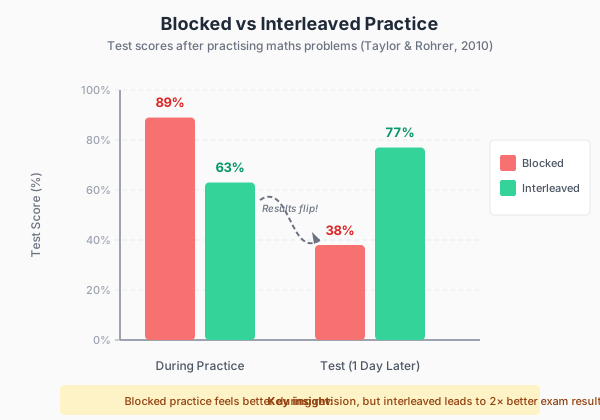
In one study, students who used interleaved practice scored nearly twice as high on a test given one day later compared to students who used blocked practice — even though both groups practised the same problems for the same amount of time.
Why does this happen?
With blocked practice, you know what method to use before you even read the question. "Oh, this is the Pythagoras section, so I'll use Pythagoras." Your brain never has to identify the problem type — it just executes the method.
With interleaved practice, you have to figure out what kind of problem you're looking at. Is this Pythagoras? Trigonometry? Similar triangles? This discrimination process is harder — but it's exactly what you have to do in an exam.
Blocked practice feels better. You get more questions right during practice. But interleaved practice prepares you for reality.
Here's the kicker: your GCSE exam is the ultimate interleaved test. Questions on percentages sit next to questions on algebra sit next to questions on geometry. If you've only ever practised in blocks, you'll struggle to identify what each question is actually asking.
The Testing Effect: Why Testing > Studying
One more piece of science that will change how you revise.
Researchers have found that the act of retrieving information strengthens memory more than the act of studying the same information.
In one experiment:
- Group A studied material four times
- Group B studied once, then took three practice tests
When tested a week later, Group B significantly outperformed Group A — even though Group A spent more time "studying."
This is called the testing effect, and it works because:
- Testing identifies gaps — You quickly discover what you don't actually know
- Testing strengthens retrieval — The struggle of trying to remember builds stronger pathways
- Testing provides feedback — You learn from your mistakes
- Testing mimics exams — You're practising the actual skill you need
The practical implication: Stop re-reading your notes. Close them and try to write down everything you can remember. Look at a problem and attempt it before checking how it's done. Use flashcards to test yourself, not just to read definitions.
Every time you test yourself, you're not just assessing your knowledge — you're actively strengthening it.
Putting It All Together
Here's what the science tells us about effective maths revision:
| What the Science Says | What This Means for You |
|---|---|
| Memory fades without reinforcement | Revisit topics at spaced intervals, not just once |
| Retrieval strengthens memory more than studying | Test yourself constantly; close your notes and recall |
| Difficulty enhances learning | Embrace the struggle; if it's too easy, find harder problems |
| Interleaving beats blocking | Mix topics in every revision session |
| Cramming only builds short-term memory | Start early; little and often beats marathon sessions |
Your brain isn't broken. You don't lack "maths ability." You just need to work with how memory actually functions.
The techniques in this Revision HQ are all built on this science. They might feel harder than your current methods — but that difficulty is exactly why they work.
Next: Learn how to apply these principles with practical strategies:
- 🔄 Spaced Repetition — How to schedule your revision for maximum retention
- 🧪 Retrieval Practice — Techniques for testing yourself effectively
- 🔀 Interleaving — How to mix topics for better results